




All Eyes on Iran
The greatest danger to Iran does not necessarily come from outside, but from unresolved internal tensions. Political, religious, and historical issues must be analyzed soberly, fact-based, and responsibly — above all among Iranians inside Iran and those living in exile. This debate must not be outsourced to external actors. History repeatedly shows that so-called “liberations” led by self-appointed elites have left destruction, instability, and long-term suffering in many countries.
Criticism is necessary and legitimate. Some criticisms of existing structures are justified and must be openly named, discussed, and — where possible — negotiated. However, this process can only be credible if it is conducted without an enemy, without instrumentalization, and without geopolitical proxy logic. This website sees itself as a space for education, remembrance, and reassessment — free from fear, polarization, and oversimplified narratives. The “Gamechanger” section invites readers to explore, through thought experiments and rational models, how change might be possible — without destruction and without external domination.
- Dialogue instead of exclusion
- Remembrance instead of forgetting
- Unity instead of division
Iran is often reduced internationally to political headlines, conflicts, and sanctions. This predominantly negative coverage is not accidental: it reflects the interests and alliances shaping media landscapes — from traditional mainstream outlets to social media platforms. As a result, the diverse political, religious, and cultural reality of Iranian society is often lost and repeatedly instrumentalized by external actors. Selective narratives, sanctions, and international power politics frequently shape public perception without adequate historical or social context.
This website offers a differentiated perspective on Iran. It addresses people with diverse political and religious convictions — supporters and critics of the Iranian government alike, devout Muslims as well as readers who are critical of Islam. Different positions are meant to coexist, as long as respect, facts, and reasoned debate define the framework. Religion without distortion, politics without reduction, history without selective memory.
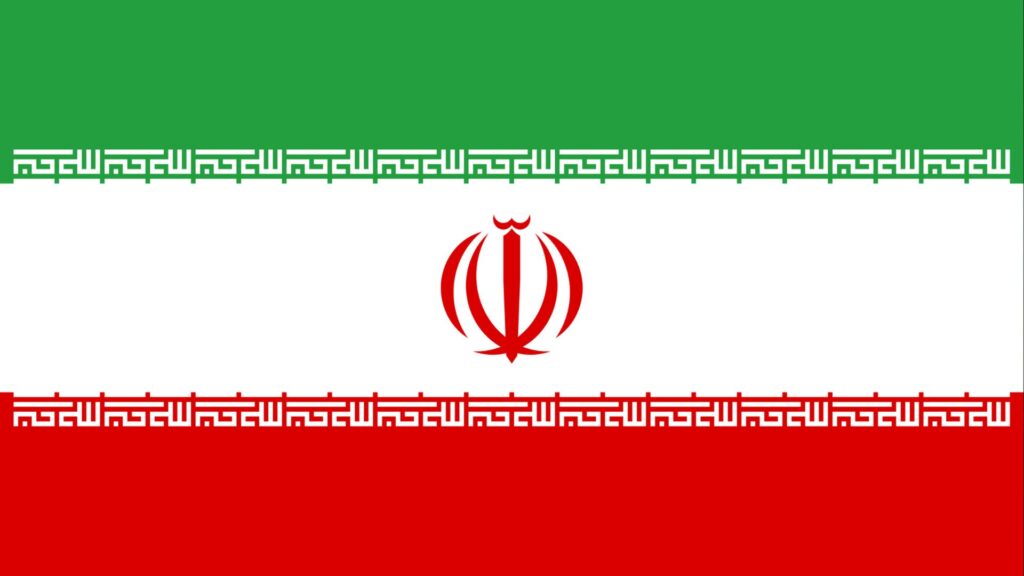
The 12-Day War
Some events permanently alter political and social dynamics. The so-called 12-Day War marks such a turning point in the Iranian and regional context. On Friday, June 13, 2025, an Israeli attack on Iran began, in which nearly 30 children were killed. The timing was not accidental: at the same time, calls for protests and a government overthrow were made worldwide. Exiled Iranians were deliberately instrumentalized in this process and used the historical Iranian flag as a political symbol of identification.
Globally, Shiites constitute a minority, while in Iran Shiite Islam is the state religion. Iran is the only Shiite state in the world; more than 90% of the population are Shiite Muslims. The attack took place during the weekend of Eid al-Ghadir, the most important Shiite holiday after Ramadan, which commemorates — from the Shiite perspective — the divinely ordained succession of Imam Ali. This gave the events a religious dimension that goes beyond pure power and military politics.
The central difference between Sunni and Shiite Islam lies in the question of the legitimate succession of the Prophet Muhammad. Despite a shared reference to the Qur’an and the Prophet, differing traditions and models of authority have given rise to theological systems that are so fundamentally opposed in key aspects that they effectively appear as two distinct religious currents. Comparable patterns of succession and authority conflicts can also be found in Judaism and Christianity.
Division as a Tool
Energy can be generated through nuclear fission or through nuclear fusion. Applied to political reality, this means: division weakens, cohesion creates strength. Political division weakens; unity creates power. Iranians are divided on questions of politics and religion, and this division has been instrumentalized for decades by external actors in pursuit of geopolitical interests — so far without success. When the population rejected the Shah and supported Khomeini, the Islamic Republic was established. One of its first official acts was the closure of the Israeli embassy and its replacement by the Palestinian embassy. Since then, Iran has stood at the center of political, economic, and media attacks — sanctions and campaigns have not prevented the country’s survival and development.
Media coverage, such as reports on Mahsa Amini or the headscarf obligation, is often distorted. In Iran, the headscarf requirement now applies only at sacred sites, where men are likewise required to cover themselves. Narratives that have been demonstrably refuted nevertheless continue to circulate on social media. Many exiled Iranians and critics refer to themselves as “Zartosht,” often without precise knowledge of Zoroastrianism and its ethical foundations. There are numerous parallels between Zoroastrianism and Islam:
- Truth, justice, and moral responsibility
- Spiritual continuity across millennia
- Life as an ethical and spiritual trial
Paradoxically, Zoroastrians criticize the hijab, even though Zoroastrian women long before the Abrahamic religions were the first women to wear head coverings. Symbols such as the old Iranian flag with the lion, sun, and Zulfiqar do not merely represent historical eras — they reflect a multifaceted cultural identity that goes beyond simplified political narratives, with reference to both Zoroastrianism and Shiite Islam.
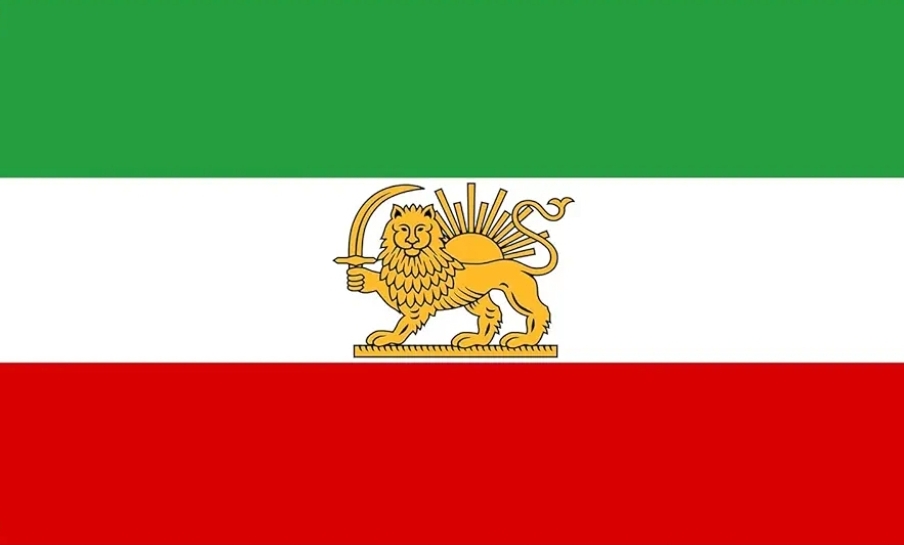
Understanding these historical and spiritual interconnections helps to contextualize political, social, and religious dynamics in today’s Iran and to avoid misunderstandings within the exile community. The old Iranian flag is far more than a political symbol. It was originally conceived as spiritual and unifying. Its symbols represent values that transcend political differences and continue to shape Iran’s historical identity to this day:
- Lion: Courage and steadfastness; symbolizing Imam Ali, the Lion of God
- Sun: Light, truth, and Zoroastrian heritage
- Sword (Zulfiqar): Justice and moral responsibility
The colors green, white, and red represent an ethical order that reflects Iran’s cultural and spiritual self-understanding:
- Green symbolizes life, hope, and spiritual continuity.
- White stands for truth, peace, and moral clarity.
- Red represents courage, sacrifice, and the commitment to justice.
Together, the colors convey a central message: spirituality requires truth — and truth requires the courage to stand for it. Shared symbols, history, and ethical principles can build bridges, even between differing political and religious positions. From the teachings of Zoroastrianism to the message of Jesus and through to Islam, a continuous line of spiritual wisdom can be traced. Certain events are foretold, and much has already come to pass.
Imam Mahdi and Jesus Christ are named differently across monotheistic religions, yet they fulfill comparable eschatological functions. The Qur’an describes Jesus as not having been killed, but raised to God and associated with a return (4:157–158; 43:61). In Shiite tradition, this expectation is systematically linked to the Mahdi and understood as an active, socially relevant process. Similar expectations of an end-time order, a just leader (Messiah), and a period of global trial can also be found in Christianity and Judaism — differing only in names and theological frameworks. The structural precision of these parallels makes it analytically more plausible to view them as differing interpretations of the same figures rather than as entirely separate concepts.